
























_2026-10-13_14-11-48.png)

“Only 4 Ingredients”: Is This The Wellbeing-Washing Of Snack Culture?
Written by: Eleanor Hoath
Written on: 6 April 2025
Are we being sold simplicity, or simply being sold to?
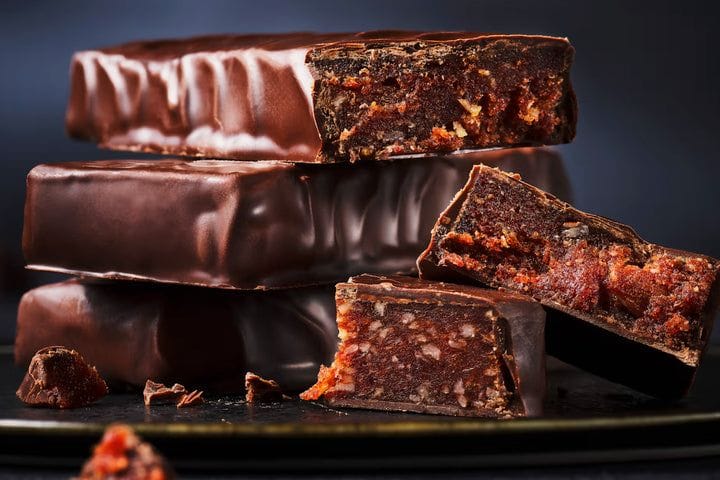
Walk into any M&S Food Hall and you'll find them: sleekly packaged snack bars boldly stamped with the promise “Only 4 Ingredients.” The message is clear - minimal, wholesome, unprocessed. A beacon for the health-conscious shopper looking for sustenance without the side of ultra processed.
But there’s a problem. Flip the bar over, and the back tells a different story. Suddenly there are, six, sometimes seven or nine ingredients. Some are familiar (almonds, dates), others less so (natural flavouring and stabilisers). So the shiny promise of clean, uncomplicated eating begins to unravel. What started as a nod to transparency becomes a masterclass in marketing, an increasingly common phenomenon in the booming world of so-called wellness foods.
We spoke to nutritionist Clarissa Lenherr and plant-based chef Bettina Campolucci Bordi to unravel what’s really going on behind the label - and what this says about the wider culture of food, convenience, and consumer trust.
The four-ingredient fantasy
This isn’t just about one bar, or even one supermarket. It’s about a cultural moment. The “whole food-focused” movement of the last decade has reshaped how we shop, how we eat, and how we judge food. Minimalism is in. Ingredient lists are out. We want purity, simplicity, and whole foods - but we also want them wrapped up, ready to go, and available at a self-checkout.
Enter the “Only 4 Ingredients” snack bar: the perfect compromise. Or so it seems. “This practice can be misleading,” says Clarissa Lenherr. “It exploits consumers’ desire for transparency and healthier choices, creating a perception that doesn’t actually match the reality.”
The front-of-pack claim speaks to a craving for control. In a world of ultra-processed everything, four ingredients feels like a safe bet. But when “natural flavourings” and hidden sugars start creeping in, trust is eroded - and consumers are left wondering what actually qualifies as healthy anymore.
The great snackification of wellbeing
There’s a bigger trend at play here. The wellness world, once niche and crunchy, is now fully mainstream and arguably ripe for exploitation. Snackification is the industry’s latest gold rush: portable, branded, highly marketable bites that promise nourishment on the go. But are they genuinely nourishing?
“I’ve never been a fan of energy bars,” says Bettina Campolucci Bordi. “Many are mostly dates, very little nuts, and sometimes protein powders. The health benefits are often deceiving.” Her go-to alternative? A handful of nuts and seeds with a few bits of dark chocolate. “It’s cheaper, it’s ‘cleaner’, and actually satisfying.”
Clarissa agrees. “A bar containing 30g of sugar per 50g serving is extremely high - even if that sugar comes from dates,” she explains. “Date paste, often used in bars, is more processed and lacks the fibre of whole dates, leading to a quicker spike in blood sugar. You get a short burst of energy - and then the crash.”
It’s a familiar cycle: grab a bar, feel virtuous, crash an hour later, crave more sugar, repeat.
Does convenience trump clarity?
So why do we keep reaching for these bars?
Convenience, of course. And for plant-based eaters especially, options can feel limited. “It depends on what the bars contain,” says Bettina. “But if it’s mostly dates, then that’s sugar at the end of the day. A handful of nuts would always be my go-to—and it’s cheaper.”
But the industry knows this. As our food becomes faster, our lives busier, and our expectations of ‘health’ more aesthetic than scientific, brands are scrambling to make wellbeing easy. Enter buzzwords like “natural”, “clean”, “simple”, and “raw”—all of which sound appealing but mean almost nothing legally.
“We’re seeing a rise in what I call wellness-washing,” Clarissa says. “Lots of plants on the packaging, lots of neutral colours - it looks healthy, but when you read the label, it’s the same as any other ultra-processed snack.”
The illusion of simplicity
The deeper irony? Making a healthier snack bar isn’t complicated. “I love a stuffed date,” Bettina says. “Fill them with nut butter or nuts, dip them in chocolate - you’ve got the perfect snack, and no hidden preservatives or sugars.”
Clarissa recommends getting familiar with the order of ingredients. “It tells you the percentage of what’s actually in the product. If sugar or dates are one of the first three ingredients, it’s likely to be high-sugar. I typically look for under 15g of sugar per 100g, which is already generous.”
She’s also a fan of keeping it old school: hard-boiled eggs, roasted chickpeas, veggie sticks with hummus, or even homemade energy balls where you control the sweetness.
Are brands getting better?
It’s not all bad. Clarissa points out that some brands - including M&S in parts of their range are making progress. “They’re using better oils, more natural sources of sugar, and fewer ingredients. There’s a clear effort to meet the demand for healthier, less processed options.”
But the responsibility doesn’t lie with brands alone. Consumers must remain sceptical. “Always scrutinise the ingredients list and nutritional information,” she says. “And especially be wary of aesthetics - just because it looks ‘clean’ doesn’t mean it is.”
So what do we take away from all this? Perhaps that our desire for health and our demand for convenience are still struggling to co-exist. In the race to simplify food, we’ve allowed branding to stand in for substance—and we’re paying for it in spiking blood sugars, empty snacks, and the slow erosion of trust in food labelling.
“Ultimately,” Bettina says, “if it says four ingredients, it should have four ingredients. If not, it’s just marketing.” And maybe that’s the real issue here. Not that M&S made a slightly misleading bar - but that we’re now so conditioned to believe the promise on the front, we forget to question the truth on the back.

This article is for informational purposes only, even if and regardless of whether it features the advice of physicians and medical practitioners. This article is not, nor is it intended to be, a substitute for professional medical advice, diagnosis, or treatment and should never be relied upon for specific medical advice. The views expressed in this article are the views of the expert and do not necessarily represent the views of Healf
Eleanor Hoath is a Registered Nutritional Therapist (DipNT, mANP, mBANT) specialising in gut, skin and women’s health. She is the Editor of The Healf Source and founder of Well Nourished Nutrition Ltd.
Passionate about holistic wellbeing and balanced living, Eleanor combines evidence-based nutrition with a practical, approachable style to help people feel their best through content.
Based in London, she is dedicated to empowering individuals to nurture their health and understand the root cause of their symptoms from the inside out.