


























_2026-10-13_14-11-48.png)


What If Your Bloating Isn’t ‘IBS’ But An Enzyme Issue?
The science behind digestive enzymes, FODMAP breakdown and how the right blend may help reduce discomfort, food fear and post-meal puffiness. Hallelujah.

Written by: Samantha Nice
Written on: 7 January 2026
If you’ve ever been told you “probably have IBS” after all your tests came back normal, you’re definitely not alone. Bloating, cramps, diarrhoea and unpredictable digestion affect millions of people, yet the IBS label often comes without clear answers or real relief. Instead, it can lead to long food avoidance lists, anxiety around eating out and the feeling that your gut is just… difficult.
But what if some of those symptoms aren’t IBS in the classic sense at all? What if they’re being driven by something far more specific, and far more manageable, like a digestive enzyme issue?
Here we spoke with Iris den Biesen, consulting dietician, at Intoleran, who works closely with those navigating food intolerances, FODMAP sensitivity and enzyme-based digestive support. Her insight paints a much clearer picture of bloating; one where supporting digestion matters more than collecting another diagnosis.
Why IBS and enzyme issues are so often confused
IBS is considered a functional diagnosis meaning it’s usually given when no structural disease or clear medical cause can actually be found. That’s part of why it’s so common, but also why it can feel pretty unsatisfying.
“There’s a significant overlap between IBS symptoms and those caused by enzyme deficiencies or food intolerances,” Iris explains. “IBS is often diagnosed when no clear medical cause is found, yet many individuals still experience digestive complaints triggered by specific meals. That, in itself, can be a strong indication that digestive enzymes might be lacking.”
In other words, if your symptoms reliably appear after eating (especially after certain foods) your digestion may be struggling with what you’re eating, not how your gut functions overall.
“In practice, we frequently see that people who have been labelled with IBS are actually dealing with one or more food intolerances… such as lactose (in dairy products) or fructans (in onion,garlic or wheat for example),” Iris says. This distinction matters, because intolerances caused by poor digestion of specific carbohydrates can often be supported; either through dietary strategies or targeted enzyme supplementation.
What are FODMAPs and why do they cause so much bloating?
A lot of enzyme-related digestive issues centre around FODMAPs - a collection of carbohydrates that are notoriously difficult to digest for some people. “FODMAP stands for Fermentable Oligosaccharides, Disaccharides, Monosaccharides and Polyols,” Iris explains. “They are a group of short-chain carbohydrates found in many everyday foods. Some people have trouble digesting them, which can lead to bloating, gas or stomach pain.” FODMAPs aren’t inherently bad. In fact, many are found in very “healthy” foods but the problem arises when they aren’t properly absorbed in the small intestine.
“You’ll find FODMAPs in several food groups,” Iris says, including:
Lactose: found in milk, yoghurt, soft cheeses and ice cream
Fructose: found in apples, pears, honey, mango and certain sweeteners
Fructans and galactans: found in wheat, rye, onions, garlic, beans and lentils
Polyols: found in stone fruits like peaches and plums, and in ‘sugar-free’ products containing sorbitol or mannitol
When these carbohydrates aren’t digested in the right way, they pass into the large intestine where gut bacteria then cause them to ferment. “Some people, particularly those with IBS, react strongly because their gut is more sensitive,” she adds. “The extra water and gas caused by FODMAPs stretch the intestinal wall and overstimulate the nerves, leading to exaggerated discomfort.”
The enzyme deficiencies most often mistaken for IBS
While IBS is often described as a single condition, enzyme issues are much more specific which is what makes them easier to support once identified. “Many people with bloating, abdominal pain or diarrhoea are told they have IBS, but in reality, their symptoms may be linked to a food intolerance,” Iris says.
The most common culprits? “In practice, we most often see issues with lactose and fructans,” she explains. Iris notes that other enzyme-related triggers include galactans (found in legumes and beans), fructose (found in some fruits and sweeteners) and sucrose, also known as table sugar (found in lots of processed foods). If that list reads like everyday eating, you’re not wrong. This is why so many people feel stuck avoiding foods rather than understanding what’s happening.
How digestive enzymes actually work
Digestive enzymes aren’t generic gut aids, they’re super specific tools designed to break down particular carbohydrates. “Digestive enzymes work much like tiny, specialised ‘scissors’ that cut up complex food molecules into smaller, absorbable parts,” Iris explains. “Each enzyme is designed to act on one particular type of nutrient, much like a key that fits only one lock.”
Here are the key enzymes involved and what each one actually does:
Lactase breaks down lactose into glucose and galactose
Alpha-galactosidase breaks down fructans and galactans
Xylose isomerase helps convert fructose into glucose
Invertase breaks down sucrose into glucose and fructose”
The goal here is to complete digestion before food reaches the large intestine. “By breaking down these sugars in the small intestine, enzymes prevent them from reaching the large intestine, where they would otherwise ferment and cause gas and discomfort,” Iris says. “This can significantly reduce FODMAP-related symptoms.”
Who benefits most from digestive enzyme support… and who won’t
Enzyme supplements aren’t a cure-all, but for the right people, they can be life-changing. “People with food intolerances, IBS, or those following a FODMAP-restricted diet often benefit from enzyme supplements, especially during social meals or when eating out,” Iris explains.
They can also be helpful for people with altered digestion following surgery. “They can be useful for individuals with shortened intestines, for example after bowel resection or gastric bypass surgery, where digestion needs to happen more efficiently in a shorter timeframe.”
Importantly, enzymes aren’t meant to replace dietary awareness but instead to support it. “While enzymes aren’t a substitute for a personalised diet plan, they can be a valuable support tool, offering more freedom, flexibility and peace of mind,” Iris says. “Especially during social occasions, travel or spontaneous meals, when strict dietary control isn’t always realistic.”
However, there are clear limits. “Digestive enzymes do not help in cases of food allergies,” she notes. “They also do not help in coeliac disease, which is an autoimmune response to gluten.”
There is one FODMAP group that remains tricky though. “Unfortunately, there is no enzyme currently available to digest polyols such as sorbitol (in avocado for example) and mannitol (in sugar-free sweets),” adds Iris.
Signs your bloating may be enzyme-related… not ‘classic’ IBS
Timing is one of the biggest clues. “The clearest sign is if symptoms like bloating, cramps or diarrhoea occur shortly after eating, usually within 30 to 90 minutes,” Iris explains. “These are typical of a food intolerance or digestive issue.”
Patterns matter too. “If symptoms are meal-related and repeat consistently after specific foods, this points more towards a digestive intolerance than ‘classic’ IBS.” Constipation can still feature; but it’s less direct. “While constipation is harder to directly link to a food intolerance, it can also be a consequence of poor carbohydrate digestion,” Iris says.
Is there real evidence behind enzyme blends?
Yes, and it starts with the enzymes themselves. “Each individual enzyme used in our supplements has been clinically studied for its specific digestive function,” Iris explains, pointing out that these aren’t experimental ingredients, but well-researched tools with established roles in digestion.
That evidence base is also why the blend itself is now being studied at scale. “Monash University, the institution behind the FODMAP diet, has specifically selected our FODMIX enzyme blend for a clinical trial in people with IBS,” she says. “This isn’t about testing whether enzymes work in theory; it’s about evaluating a formulation built from enzymes that already have strong individual evidence behind them.”
The study is ongoing, with results expected next year, but its very existence signals an important shift. Rather than relying solely on long-term food avoidance, research is increasingly exploring how targeted enzyme support may help people digest problematic foods more comfortably.
How enzyme support can reduce food fear
For many people, bloating isn’t just a physical thing. It can also be emotional. “Digestive symptoms can lead to anxiety, food avoidance and even social isolation,” Iris explains. “People may feel uncomfortable explaining their needs in restaurants or at social gatherings, especially if they’re unsure which ingredients will cause problems.”
Targeted enzyme support can change that relationship. “Once someone discovers they can enjoy a certain meal without symptoms, thanks to enzymes, it brings back trust, spontaneity and joy in eating,” she says. “Instead of dreading the aftermath of a meal, they can focus on enjoying the moment and the people around them.”
Where enzyme blends like Fodmix Quatrase fit in
If your bloating reliably shows up after certain meals (we’re talking dairy-heavy dishes, wheat-based foods, onion- or garlic-rich meals, desserts or eating out), a targeted enzyme blend like Fodmix Quatrase is a wise addition to your supplement stack.
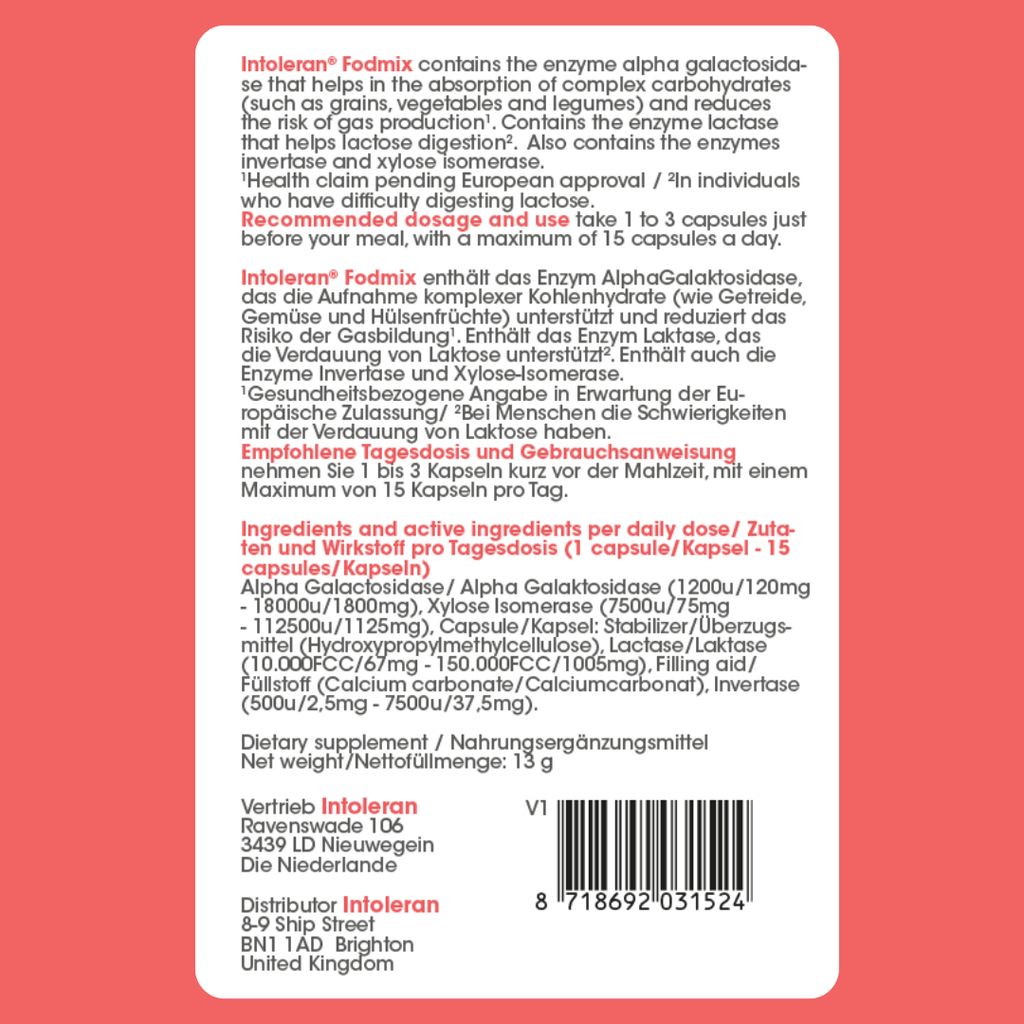
Designed specifically for this scenario, it combines several high-dose digestive enzymes that work on the most common FODMAP triggers, rather than focusing on just one intolerance. Each capsule delivers 10,000 FCC units of lactase to support lactose digestion, alongside alpha-galactosidase for fructans and galactans, xylose isomerase to help convert fructose into glucose, and invertase to break down sucrose.
Taken just before a meal, the goal is simple: help complete digestion in the small intestine so these carbohydrates don’t reach the large intestine and ferment. The capsules can also be opened and mixed into food or drink, making them suitable for children over two and useful when swallowing capsules isn’t ideal. Being Low-FODMAP Certified, gluten-free and soy-free, it was made to slot into real life social meals, travel, or moments when full ingredient control isn’t realistic.
As Iris emphasised earlier, enzyme supplements aren’t a replacement for understanding your triggers or working with a dietitian, but they can offer flexibility, confidence and relief when food fear starts to creep in.

The takeaway
Not all bloating is IBS, and not all digestive discomfort requires lifelong restriction. For many people, symptoms labelled as IBS may actually stem from very specific enzyme limitations… particularly when it comes to digesting FODMAPs. As Iris emphasises, “It’s always worth exploring whether a food intolerance is part of the problem, ideally together with a dietitian who can guide you in finding the right triggers and solutions.”
Digestive enzymes aren’t a shortcut or a replacement for personalised care, but they can be a practical tool for restoring confidence, comfort and freedom around food. A simple way to explore whether enzymes could help? Take them with the meal that typically triggers symptoms and notice what happens. Sometimes the issue isn’t your gut, it’s just that it needs a little help breaking certain foods down.



This article is for informational purposes only, even if and regardless of whether it features the advice of physicians and medical practitioners. This article is not, nor is it intended to be, a substitute for professional medical advice, diagnosis, or treatment and should never be relied upon for specific medical advice. The views expressed in this article are the views of the expert and do not necessarily represent the views of Healf
Samantha Nice is a seasoned wellness writer with over a decade of experience crafting content for a diverse range of global brands. A passionate advocate for holistic wellbeing, she brings a particular focus to supplements, women’s health, strength training, and running. Samantha is a proud member of the Healf editorial team, where she merges her love for storytelling with industry insights and science-backed evidence.
An avid WHOOP wearer, keen runner (with a sub 1:30 half marathon) hot yoga enthusiast and regular gym goer, Samantha lives and breathes the wellness lifestyle she writes about. With a solid black book of trusted contacts (including some of the industry’s leading experts) she’s committed to creating accessible, well-informed content that empowers and inspires Healf readers.