










































_2026-10-13_14-11-48.png)


Rick Rubin's Guide to Meditation
Here's exactly how the legendary music producer finds inner peace using Transcendental Meditation.

Written by: the Healf Editors
Written on: 29 July 2026
American music producer Rick Rubin has produced some of the biggest records of the last forty years, from Run-DMC to Johnny Cash to Adele. But ask him what's shaped his life most, and he points to something that has nothing to do with a mixing desk: meditation.
He's mentioned it in interview after interview. The twice-daily practice he started as a teenager has, by his own account, affected him more than anything else he's done. For someone whose whole job is hearing what a song needs, that feels somehow appropriate. Rubin treats his attention as the raw material he needs to work, and meditation as the way he keeps his head clear.
So what does one of the most influential people in music actually do when he sits down to meditate? There's a mantra Rubin has used for decades, a handful of simple practices anyone can borrow, and an honest take on what meditation can and can't do. Here's how he approaches it, and how you might start your own practice.
Where it began
Rubin was 14 when a sore neck sent him to the doctor. As he told Rolling Stone, the pain turned out to be stress, and the advice was to learn to meditate. He took up Transcendental Meditation, or TM, partly because the Beatles had studied it with the Maharishi Mahesh Yogi.
TM is a mantra-based practice: you sit with your eyes closed and silently repeat a sound for around 20 minutes, letting the mind settle. Rubin still approaches his meditation in roughly the same way, meditating in the morning and again before dinner, and fitting sessions in on planes between studio dates.
The three ways in
In 2023, Rubin appeared in a YouTube video where he laid out the three main approaches to his practice. Mantra meditation uses a repeated sound or word to gently occupy the thinking mind. Awareness meditation asks you to sit with whatever comes up — a sound, a sensation, a passing thought — without grabbing at it. Loving-kindness is quietly wishing wellbeing towards yourself and other people. Rubin's simple mantra is: "May I be filled with loving kindness, may I be well, may I be peaceful and at ease, may I be happy."
It all connects to how he talks about meditation and creativity as one muscle. In his 2023 book, The Creative Act, Rubin describes awareness as a kind of open presence with whatever is happening — the same quality of attention he brings to a record.
What the science actually says
The most-cited scientific review, a 2014 meta-analysis in JAMA Internal Medicine that pooled 47 trials and more than 3,500 people, found meditation programmes gave small-to-moderate improvements in anxiety and depression. For other things people often hope for, like sharper attention, better mood, or deeper sleep, the researchers said the evidence was thinner.
The benefits for your nervous system are probably the strongest. In the moment, meditation does measurably shift things: ECG studies during a meditation session show a rise in vagal (parasympathetic) activity and a dip in sympathetic activity, showing that your brain and body are calming down. There's also decent evidence that meditation lowers cortisol, particularly in people who are already under strain. A 2020 meta-analysis found a meaningful reduction in at-risk and clinical groups, and a broader 2023 review of stress-management interventions found a similar effect across mind-body practices generally.
When you go in with grounded expectations, it can still earn its place in your day. Rubin frames it as a way to clear enough mental noise to hear what's actually there.
How to try it yourself
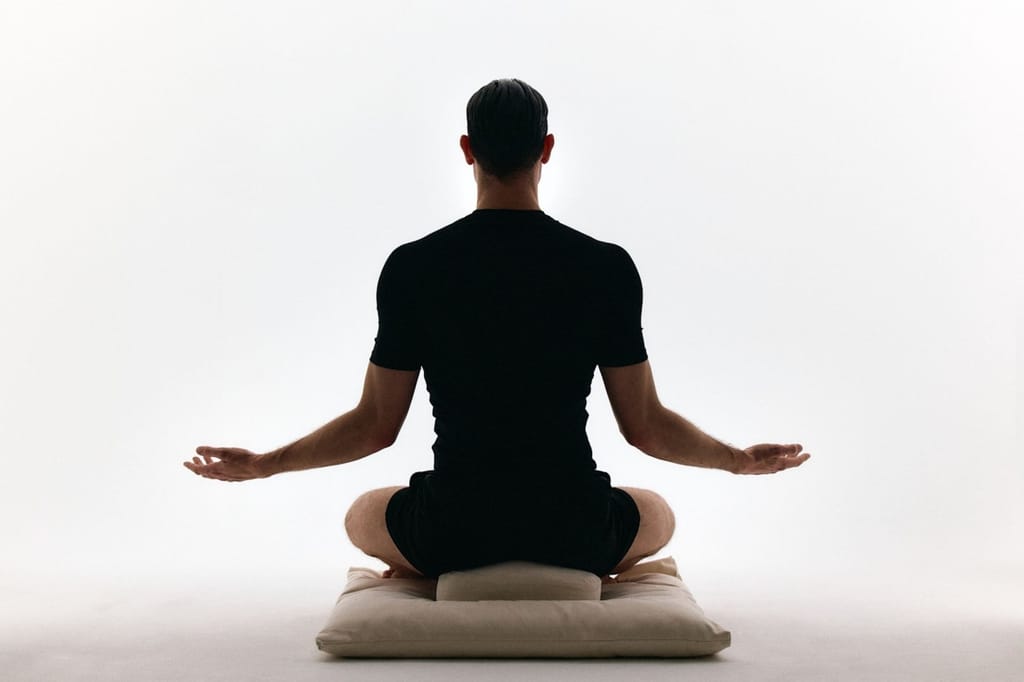
You don't need a formal TM mantra to begin, even though that's how Rubin started his journey. Borrow the shape of his practice instead:
- Pick a time and protect it. Rubin goes morning and early evening. Once a day is a fine start.
- Sit comfortably, eyes closed, and set a gentle timer for 10 to 20 minutes.
- Silently repeat a simple word or sound, or rest your attention on your breath and let thoughts drift past. You can choose whichever way is best for you.
- When your mind wanders — and it will — notice it and come back, without giving yourself a hard time. The coming back is the practice.
- Find a gentle re-entry point. Sit for a few breaths before you stand up and step back into the day.
Start small and let it settle into a habit before you judge it. As Rubin tells it, the win is simply showing up again tomorrow.


This article is for informational purposes only, even if and regardless of whether it features the advice of physicians and medical practitioners. This article is not, nor is it intended to be, a substitute for professional medical advice, diagnosis, or treatment and should never be relied upon for specific medical advice. The views expressed in this article are the views of the expert and do not necessarily represent the views of Healf
Healf's editorial team works hard to produce science-backed, expert-vetted stories to break down trends and cut through the noise in the wellbeing ecosystem. Our team of writers and editors specialise in everything from nutrition, to exercise science, women's health, skincare, sleep, and more.